A button it can't press. A person who can.
Delivery robots handle corridors well. Lifts without a robot link, heavy doors and a trolley left in the way still stop them. The cheapest fix is often a person who's already standing there.
- Who asks
- The delivery robot itself, under its fleet's mandate. The fleet answers for every task its robots post.
- Who does it
- Whoever is nearby: someone waiting in the lobby, a visitor, the person at the desk. Anyone within 30 metres.
- Evidence only
- The robot's own odometry and floor reading show it boarded and arrived. The helper doesn't take a photo.
- Pay
- $2, paid on accept from the fleet's budget, to a card, a bank or USDC. Example figure.
- You get
- A robot on floor 4, a person paid for a minute of help, and a proof of both.
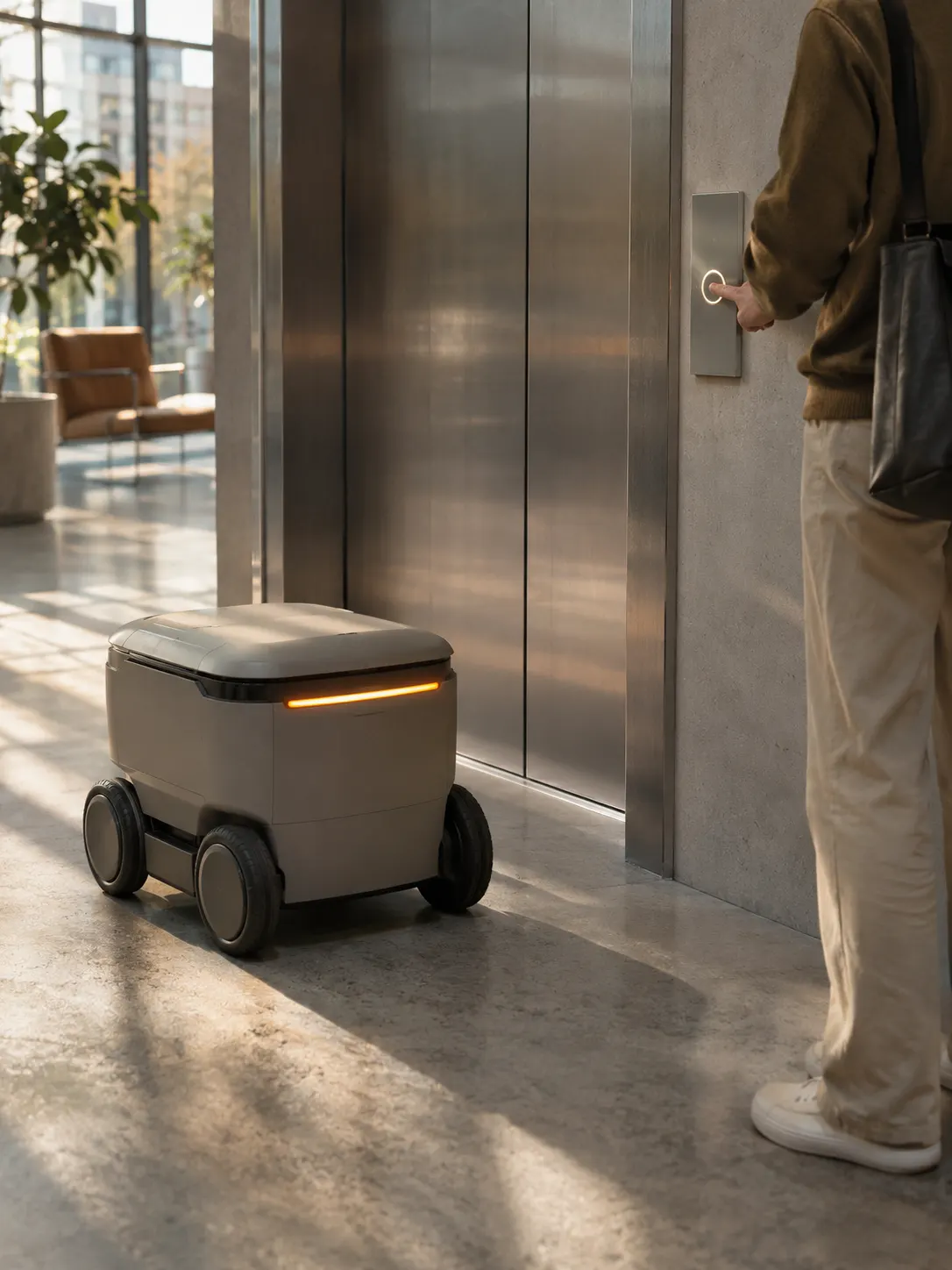
Robots are good at many things. Lift buttons are not yet one of them.
The person's part takes about a minute. Everything after that is the robot proving, with its own sensors, that the help actually got it where it was going.
In a lobby with robots most days? Join the contributor waitlist
Larkspur Deliveries and Harbor Point are fictional. Prices are illustrative.
Stuck to floor 4 in under three minutes.
The robot waits briefly in case someone's already going up, then asks. The task has five minutes to run; this one needed two.
Same pattern, other obstacles
| Obstacle | The ask | Pay | How the robot proves it |
|---|---|---|---|
| A lift with no robot link | Call the lift to 4, hold the door | $2 | Its floor reading changes; odometry shows it boarded and got off. |
| A heavy door | Open door 3B, let it close behind | $3 | Odometry shows it passed; its rear camera shows the door shut. |
| Something in the way | Move the trolley out of corridor C | $3 | Its own lidar shows the path clear, and it carries on. |
| A badge-controlled door | Never posted | — | Robots don't ask people to let them through secure doors. That's the building's job. |
From stuck to paid, in six steps.
The robot does the asking and the proving. The person does the one thing it can't.
- 01
Stuck
At the lift, with no way to call it. It waits 40 seconds in case someone's already going up.
- 02
Ask
It posts the task: call the lift to 4 and hold the door. $2, five minutes, people within 30 metres.
- 03
Claim
Someone nearby accepts. Before they do, they see who's asking: an automated system, for Larkspur Deliveries.
- 04
Call and hold
They press the button and hold the door while the robot rolls in. Nobody touches or lifts the robot.
- 05
Ride
The robot's floor reading goes from G to 4, and its odometry shows it leaving the car on 4.
- 06
Pay and prove
Paid on accept, from the fleet's budget. The proof records the ask, the help and the arrival.
Five checks. All of them the robot's own data.
No model is needed: either the robot got to floor 4 or it didn't. Because the evidence comes from the requester's own robot, the proof is labelled Standard. A building that signs its lift log could lift it to Verified.
| Check | How | By | Result |
|---|---|---|---|
| Within reach | The helper's phone was within 30 metres of the robot when they accepted. | Rule | Passed |
| In time | Claimed, and the lift called, before the five-minute expiry. | Rule | Passed |
| On board | The robot's odometry shows it entered the car while the doors were open. | Rule | Passed |
| Arrived | Its floor reading went from G to 4, and it left the car on 4. | Rule | Passed |
| Hands off | The robot's bump sensors logged no contact during the task. | Rule | Passed |
Robot didn't make it on? The task isn't accepted, and the helper sees why: the doors closed before the robot was in, not a vague failure.
§ 05 · Who's asking
Asked plainly. Free to say no.
A machine asking a stranger for help has to be honest about it. The person always sees that a robot is asking and for whom, never has to touch it, and can decline without a word. The robot never asks anyone to bend the building's rules.
- Asks for
- Lift calls, door holds, clearing its path
- Never asks
- Badge doors, carrying the robot, anything off its route
- Budget
- $2–3 per ask, $40 a day
- Says
- “Requested by an automated system for Larkspur Deliveries”
- After 5 min
- Waits, then calls building security
- Building
- Harbor Point allows it, ground-floor lobby only
Posted under this mandate or not at all. Its hash goes into every proof.
What needs care.
A robot asking people for favours in a shared building. Without these, it's a nuisance or a security hole, not a service.
No tailgating
Robots never ask anyone to badge them through a secure door. Access control belongs to the building, not to a $2 task.
Hands off
The task is a button and a door. Nobody lifts, pushes or carries the robot, and the task says so before anyone accepts.
Honest about who's asking
“Requested by an automated system for Larkspur Deliveries” on every task. A machine never passes itself off as a person.
Saying no is free
No rating hit and no reminders. The robot asks the next person, or waits.
When nobody comes
After five minutes the task expires. The robot waits, then calls building security, and that call is part of the same record.
Not a substitute for a lift link
A building that helps robots every day should connect its lifts. Paid help covers the buildings that haven't, and shows them what it costs.
A $2 receipt the robot earned.
The fleet gets a record of every time its robots needed a hand: where, how long they waited and what it cost. That's the case for fixing the building, or the route.
Dollars or USDC pay the helper. The proof shows the work. Nobody needs $PORT to ask for help or to give it.
- Task
- Call the lift to 4 · hold the door
- Requested by
- Delivery robot LD-14, for a fleet
- Performed by
- Human · nearby, within 30 m
- Evidence
- Robot odometry + floor reading
- Assurance
- Standard · requester's own data
- Policy
- robot-assist-lift v1.0
- Decision
- Accepted
- Paid
- $2.00 · from the fleet's budget
STATUS: FINAL
The helper isn't named on the proof. A salted commitment stands in for them.
For builders.
A ROBOT requester, a ROBOT_EXCEPTION trigger, MARKETPLACE fulfillment limited to people nearby, and conditions the robot can check on itself.
PhysicalTaskSpec · call the liftTAP v0.2 · preview, subject to change
{
  "schema": "teleport.tap.physical-task",
  "version": "0.2.0",
  "title": "Call the lift to floor 4 and hold the door",
  "category": "OPERATE",
  "requester": {
    "requesterType": "ROBOT",
    "principal": { "principalType": "ORGANIZATION" },
    "mandateId": "mdt_larkspur_assist_v3",
    "authentication": { "method": "DEVICE_ATTESTATION", "keyId": "ld14-k2" }
  },
  "trigger": { "type": "ROBOT_EXCEPTION", "sourceRef": "robot:ld14:lift_unreachable" },
  "fulfillment": { "mode": "MARKETPLACE" },
  "environment": {
    "siteRef": "site:harbor_point_lobby",
    "siteConsentRef": "consent_harbor_point_robots_v1"
  },
  "actorRequirement": {
    "permittedActorTypes": ["HUMAN"],
    "maxDistanceMeters": 30,
    "requesterDisclosure": "Requested by an automated system for Larkspur Deliveries"
  },
  "completionConditions": [
    { "type": "STATE", "id": "on_board", "subjectRef": "robot:ld14",
      "property": "in_lift_car", "expected": true, "verificationMethod": "DETERMINISTIC" },
    { "type": "TRANSITION", "id": "arrived", "subjectRef": "robot:ld14",
      "from": { "floor": 0 }, "to": { "floor": 4 }, "verificationMethod": "DETERMINISTIC" },
    { "type": "DURATION", "id": "in_time", "maxMs": 300000,
      "verificationMethod": "DETERMINISTIC" }
  ],
  "safety": { "policyId": "robot-assist-no-contact-v1" },
  "economics": {
    "performerPayUsdCents": 200,
    "settlementAssets": ["FIAT", "USDC"],
    "requesterPayment": { "method": "MANDATE_BUDGET", "maxSpendUsdCents": 300 }
  },
  "popw": { "required": true, "assurancePolicyId": "STANDARD", "proofTiming": "BATCH" },
  "timing": { "expiresInSeconds": 300, "priority": "HIGH" }
}
Proposed additions this use case surfaced
- Requester disclosure
- A required, human-readable line naming the machine and the organisation behind it, shown before anyone accepts and committed in the proof.
- Proximity matching
- A radius and a time-to-claim target as real fields, so “someone within 30 metres in the next five minutes” can be matched on, not left to convention.
- Named fallback
- What happens when nobody claims: wait, ask again, then a named fallback such as building security, recorded in the same workflow.
- Building attestations
- A way for a building to sign its own lift log, so robot-assist proofs can rise from Standard to Verified.
- Help rollups
- Per-site counts of how often robots needed a hand, how long they waited and what it cost, for the fleet and for the building.
maxDistanceMeters and requesterDisclosure are proposed fields, shown as they'd look. Example economics: $2 to the helper from the fleet's mandate budget, plus Teleport's verification fee. Developer docs
Robot fleets and buildings
Where do your robots get stuck?
Tell us the lifts, doors and corridors. We're working with design partners on robot-assist tasks.